
Kitchen
Money paths. Auth. Anything regulated.
No unsupervised guests. Ever. Two-key changes.
Hosting the AI Slop Party
House RulesThe file set from The AI Slop Party. Rooms by blast radius, gates at the door, and agents that read the fridge.
Shoes off. Apron on.
The house is your codebase, or every codebase your team contributes to. Rooms say how much damage a change can do. Gates make a PR prove it belongs in the room it touches. Agents follow the same rules as the people. This site is the repository’s own markdown, rendered; the README has every command.
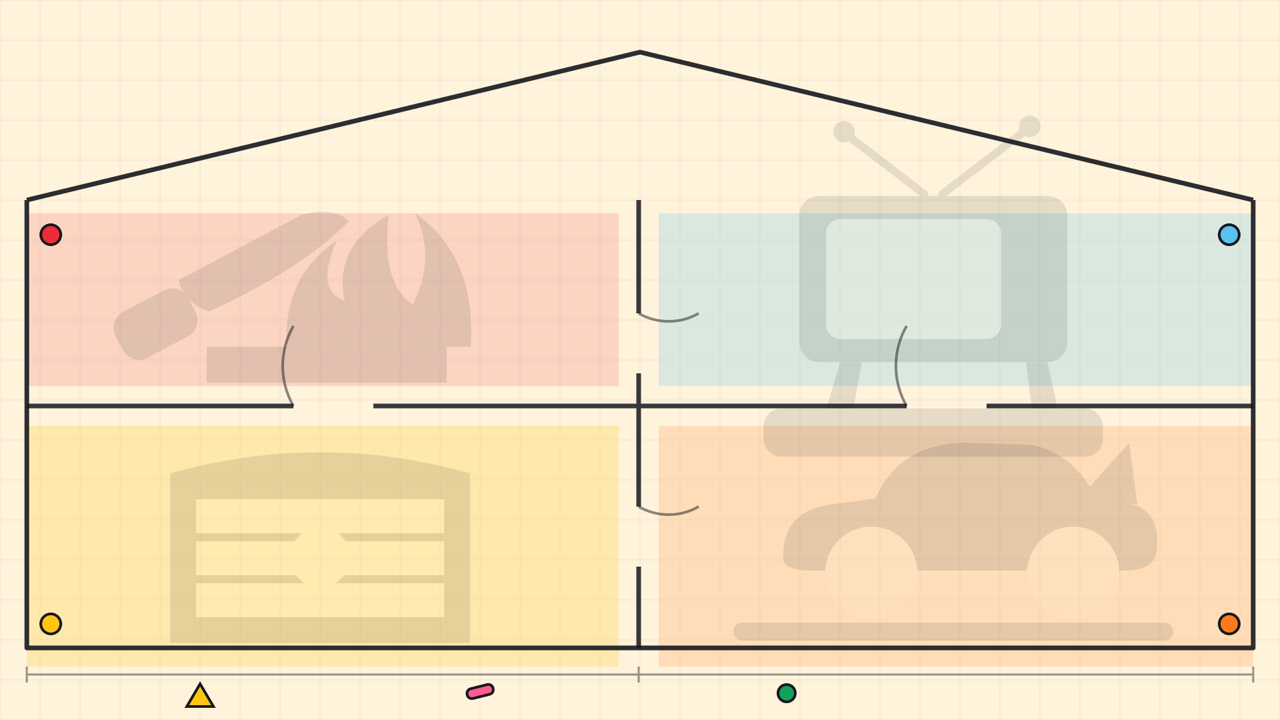
Every path in the repo lives in a room. The room sets the gate.
Money paths. Auth. Anything regulated.
No unsupervised guests. Ever. Two-key changes.

Core product. The game's on in here.
Normal review, normal gates. Everybody sees it break.

Prototypes, spikes, weird ideas. Go nuts.
One rule: the garage door stays shut.

Dashboards, scripts, Thursday's analysis.
Zero gates. Mandatory expiry. 90 days, then it gets towed.
Cryptography, secure storage, key material. It sits on top of whatever room the path is already in.
Two senior approvals, one from security.
A PR can touch several rooms and must tick every one. Automation labels the rooms from the diff, so nobody argues about it. Why tiers, and why by blast radius: ADR-0001.
Short, generic, read before you cook: AGENTS.md, plus one page of platform rules per stack.
CODEOWNERS, the dependency gate and the room workflows read the base commit, so a PR cannot loosen its own rules: room automation and quality gates.
Every rule stands on a decision that says why, so nobody has to relitigate it at the party.

The guests read the fridge before they touch anything. 41 agents
by domain, hosted by host-agent and orchestrated by eng-manager-agent.
Skills such as architecture-review give them a procedure to
follow. Each agent carries a House practices section built from team memory, so
the mistakes made here once stay made once.
flowchart LR
  subgraph Rules["Rules on the fridge"]
    A[AGENTS.md] --> P["platform/AGENTS.stack.md"]
    ADR[adr/ decisions]
  end
  subgraph Door["The door: .github/"]
    R[house/rooms.config.js] --> W[room workflows]
    CO[CODEOWNERS]
    Q[stack quality workflows]
    G[dependency gate + secret scan + PR hygiene]
  end
  subgraph Guests["Guests: .claude/"]
    H[host-agent] --> E[eng-manager-agent] --> S[specialist agents]
    H --> SK[skills]
    M[(agent-memory)]
  end
  Rules -- read by --> Guests
  Rules -- enforced by --> Door
  PR([pull request]) --> Door
  Guests -- open --> PR
Read Assumptions first. It lists every guess v1 makes about your repo and how to check each one; only you know where your Kitchen is.
| You want… | Start with | Then read |
|---|---|---|
| the agents and skills everywhere you work | A personal agent set | Agents, Skills |
| one repo to follow the house rules | One repository | House rules, Platform rules |
| the same house across several repos | A set of repositories | Decisions, Agents |
| a tool other than Claude Code | Other AI systems | Which system reads what |